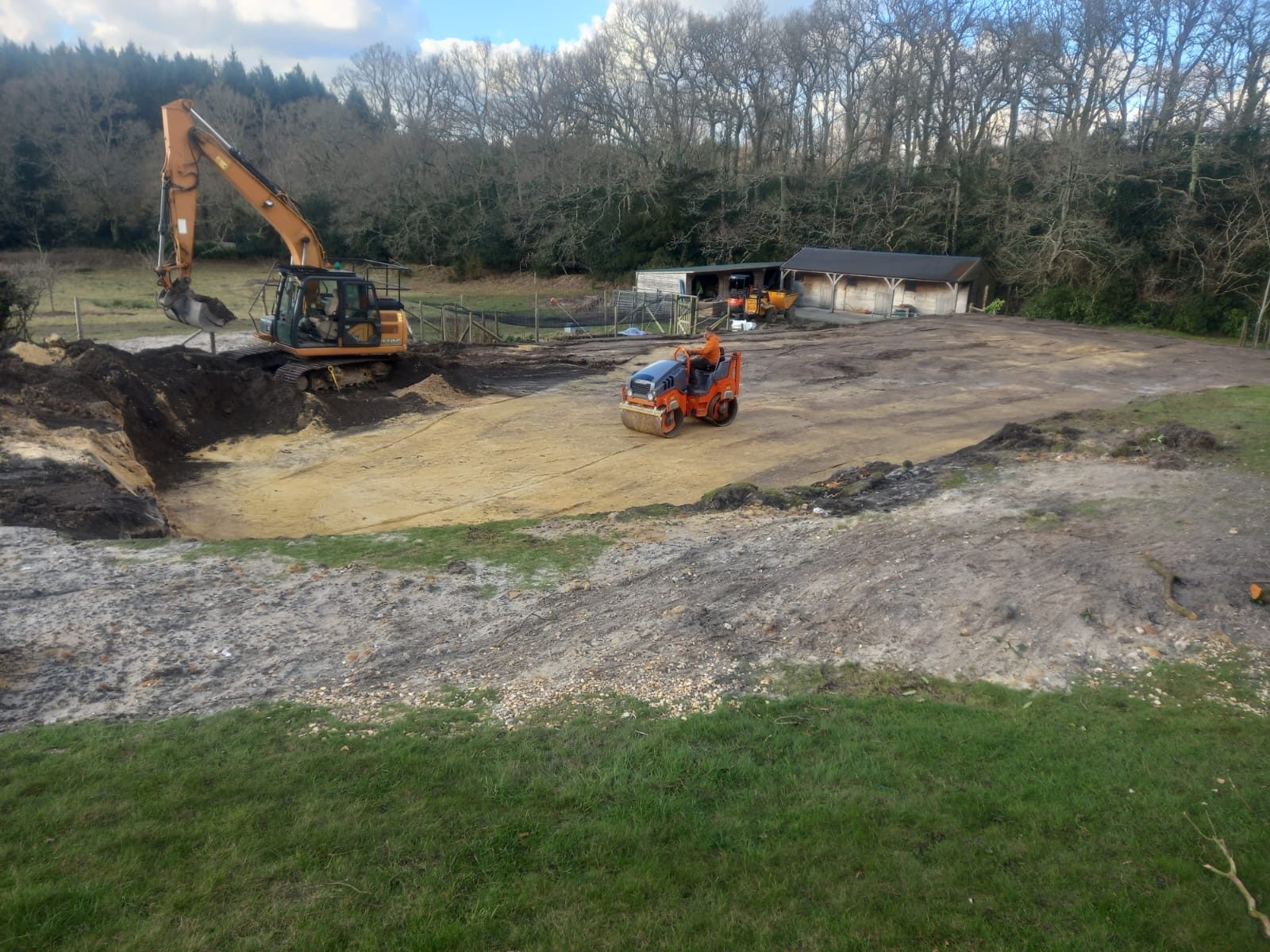
Why is my garden waterlogged?
- Clay soil: much of Surrey sits on Weald Clay or London Clay, which drains very slowly, so water sits on the surface through the winter.
- Compaction: building work, machinery and heavy foot traffic squash the soil and stop water getting through.
- Run-off: water from roofs, patios and driveways often ends up on the lawn.
- Springs and high water tables: some low-lying gardens and fields are simply wet for much of the year.
- Blocked or broken old land drains, which are common on older properties and farmland.
Drainage options
- French drain: a gravel-filled trench wrapped in geotextile with a perforated pipe at the bottom. It collects water along its length and carries it away. Ideal along the bottom of a slope or the edge of a lawn.
- Land drainage (herringbone drains): a network of perforated pipes laid across a lawn, paddock or field, feeding into a main drain. Used for larger areas.
- Soakaway: an underground pit or crate system that lets collected water soak gradually into the ground. It only works where the soil drains well enough, which a percolation test checks.
- Discharge to a ditch or watercourse: often the best outlet on clay. You may need consent from the Lead Local Flood Authority (in Surrey, Surrey County Council) to alter or connect to an ordinary watercourse.
- Soil improvement: aerating, adding grit and organic matter, or raising beds helps where the problem is mild.
Rules to know
- Building regulations (Part H) say soakaways should normally be at least 5 metres from a building and sized from a percolation test.
- You can't connect surface water to the foul sewer, and connecting to a public surface water sewer needs consent from the water company.
- You mustn't divert water onto a neighbour's land in a way that causes them flooding.
How we install a French drain
- 01
Find the source
We look at levels, soil and where the water comes from, and dig a test hole if a soakaway is being considered.
- 02
Plan the route and outlet
We set out the drain line with a steady fall, typically at least 1 in 100, to a soakaway, ditch or approved outlet.
- 03
Excavate the trench
The trench is dug to the planned depth and fall, usually with a mini digger to keep the line accurate.
- 04
Lay membrane and pipe
Geotextile membrane lines the trench, a bed of clean stone goes in, then the perforated pipe is laid to fall.
- 05
Backfill with stone
The trench is filled with clean washed stone and the membrane folded over the top to stop soil clogging it.
- 06
Reinstate
We finish with gravel, topsoil and turf, or a surface to suit, so the drain blends in.
Frequently asked questions
Got a waterlogged garden or field?
Free site visits across Surrey & Sussex. Tell us about your project and we'll be in touch.